
Wet Waste Recycling
Food waste and garden/landscaping waste for composting and bio-methanation.
Compliance
CPCB Authorized
Audit Trail
Official Certificate
Experience
25+ Yrs Leadership
Certified Wet Waste Recycling
Full chain-of-custody collection, authorized processing, and CPCB green audit clearance across NCR.
Understanding Wet Waste Recycling in India
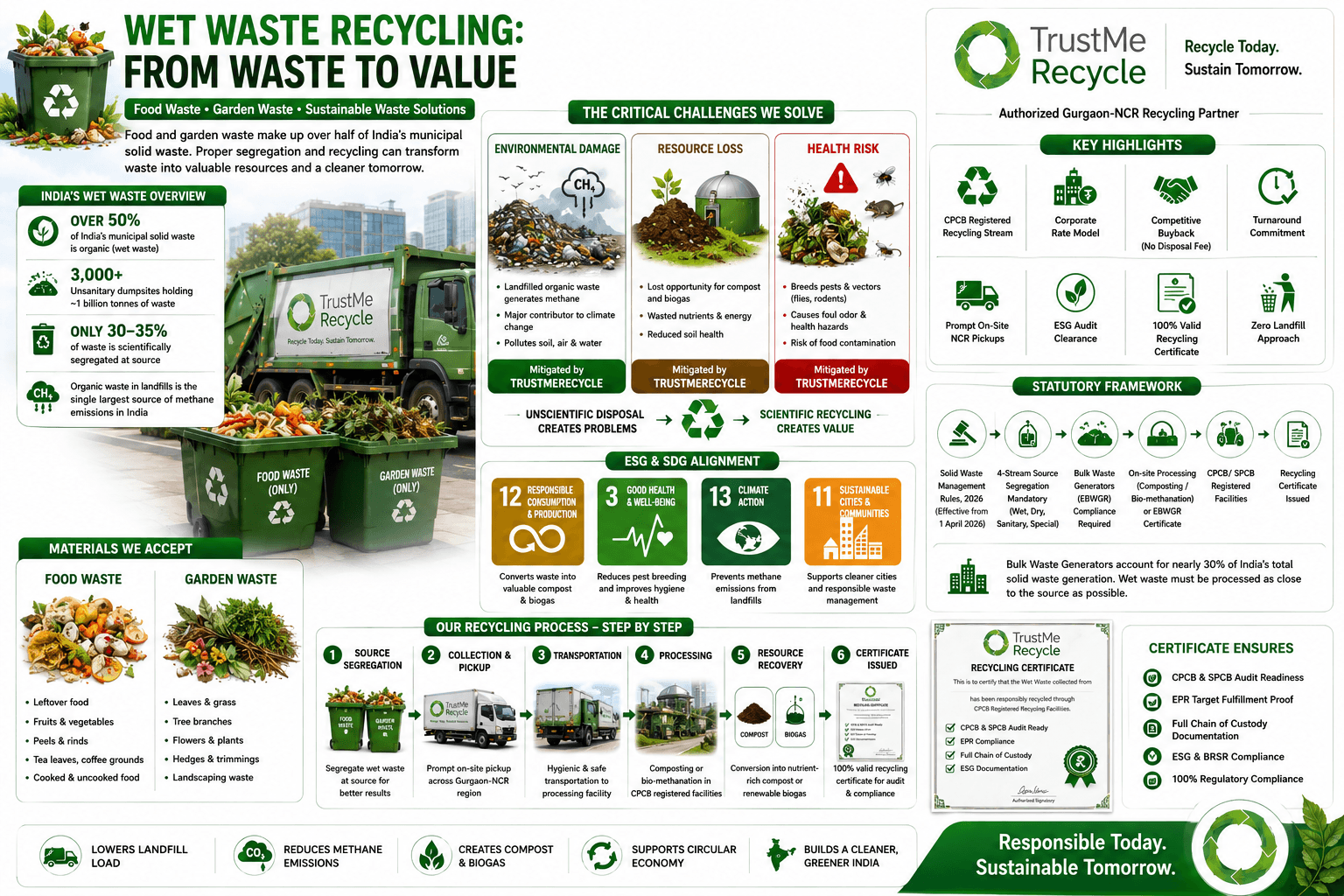
Food waste and garden waste make up over half of India's total municipal solid waste by weight — organic material that's suitable for composting or bio-methanation when properly separated at source, but that too often ends up mixed with dry waste in a single bin and landfilled instead. India has over 3,000 unsanitary dumpsites holding around 1 billion tonnes of unmanaged waste, and only 30–35% of the country's waste is scientifically segregated at source, which sharply limits how much organic waste is actually recovered for composting rather than dumped (government waste-management data, 2025-26). For hotels, hospital cafeterias, corporate campuses, and food-service operations, wet waste is generated daily and in volume — and it's the one waste stream where source segregation makes the single biggest difference to what can be recovered.
TRUSTMERECYCLE collects food waste and garden/landscaping waste from businesses and routes it to composting and bio-methanation facilities instead of landfill, where organic waste is the single largest driver of methane emissions from India's dumpsites.
Key Highlights
Processing Model
CPCB Registered Recycling Stream
Corporate Rate Model
Competitive Buyback (No Disposal Fee)
Turnaround Commitment
Prompt On-Site NCR Pickups
ESG Audit Clearance
100% Valid Recycling Certificate
Materials We Accept
The specific wet waste sub-types TRUSTMERECYCLE buys, collects, and routes to compliant recycling.
The Critical Challenges We Solve
Unregulated waste disposal creates severe health risks, environmental damage, and financial losses.
Environmental Damage
Organic waste landfilled instead of composted decomposes anaerobically, generating methane — a greenhouse gas many times more potent than CO2 over a 20-year timeframe — making unmanaged wet waste one of the largest preventable emissions sources in India's waste sector.
Resource Loss
Composted or bio-methanated organic waste becomes usable soil amendment or biogas; landfilled, it becomes pure emissions and lost landfill capacity instead.
Health Risk Breakdown
Unsegregated wet waste mixed with dry and sanitary waste creates conditions for pest and vector breeding (flies, rodents) at storage points and dumpsites, a recognised public-health issue around uncontrolled municipal dumps. Properly managed, source-segregated wet waste processed through composting or bio-methanation removes this risk close to the point of generation rather than letting it accumulate at a distant landfill.
Environmental Impact
Composting and bio-methanation convert food and garden waste into soil amendment or biogas, avoiding the methane generation that happens when the same material decomposes anaerobically in a landfill. Because over half of India's municipal solid waste is organic, properly diverting wet waste has an outsized impact on a facility's total landfill contribution compared with equivalent volumes of dry waste.
UN SDG & Corporate ESG Alignment
Partnering with TRUSTMERECYCLE provides auditable proof for corporate BRSR disclosures and international sustainability standards.
Source-segregated wet waste management supports SDG 13 (Climate Action) through avoided methane emissions, and SDG 12 (Responsible Consumption and Production) by converting food and garden waste into usable compost or biogas rather than treating it as pure loss. For hospitality, healthcare, and corporate campus operators, documented wet-waste diversion is an increasingly visible line item in green-building certification and ESG reporting.
Responsible Production
Keeps recoverable materials inside circular manufacturing chains.
Good Health & Well-being
Eliminates toxic exposure in informal dismantling chains.
Climate Action
Reduces emissions tied to virgin mining and illegal burning.
Sustainable Cities
Prevents unauthorized waste dumping across urban NCR.
Regulatory Rules & Legal Protection
Wet waste management in India is governed by the Solid Waste Management Rules, 2026, notified 28 January 2026 and in force from 1 April 2026, which mandate four-stream source segregation — wet, dry, sanitary, and special care. Wet waste, defined as organic and biodegradable material including food and garden waste, must be processed as close to the source as possible through composting or bio-methanation. Bulk Waste Generators (any entity with 20,000 sq m or more floor area, 40,000+ litres/day water use, or 100+ kg/day waste generation) are required under Extended Bulk Waste Generator Responsibility (EBWGR) to process wet waste on-site where feasible, or obtain an EBWGR certificate where on-site processing isn't practical — bulk generators account for nearly 30% of India's total solid waste generation.
Recycling Certificate Issued
Every consignment concludes with an official document suitable for corporate audits, EPR compliance, and government inspections.
How TRUSTMERECYCLE Handles Wet Waste
A transparent 6-step recycling lifecycle built for scale, accountability, and regulatory clearance.
Assessment & Collection Plan
We assess your food and garden waste volume and design a collection schedule matched to your generation rate.
Frequently Asked Questions
Ready to Clear Out Your Wet Waste?
Schedule a free on-site evaluation in Gurugram & NCR. Get fair competitive market pricing, prompt pickup, and official CPCB compliance certificates.