
Computer & IT Waste Recycling
Desktops, laptops, servers, motherboards, and IT peripherals, bought at competitive rates.
Compliance
CPCB Authorized
Audit Trail
Official Certificate
Experience
25+ Yrs Leadership
Certified Computer & IT Waste Recycling
Full chain-of-custody collection, authorized processing, and CPCB green audit clearance across NCR.
Understanding Computer & IT Waste Recycling in India
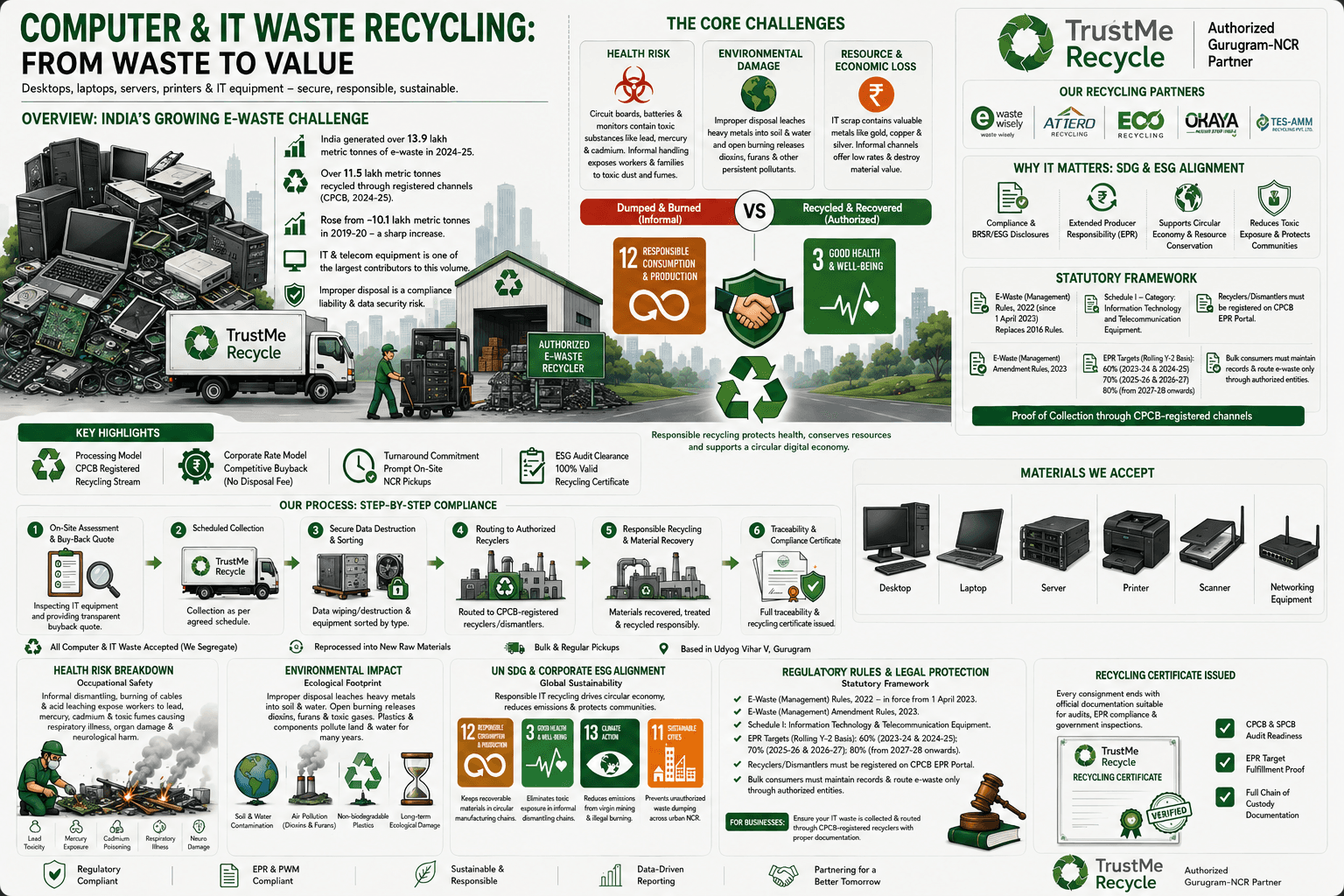
Every laptop refresh cycle, server decommissioning, and office relocation leaves behind a trail of obsolete IT hardware — desktops, laptops, servers, motherboards, RAM modules, keyboards, printers, and LCD/TFT monitors. This is the fastest-growing and most data-sensitive slice of India's e-waste stream. Nationally, India generated over 13.9 lakh metric tonnes of e-waste in 2024-25, of which the CPCB recorded over 11.5 lakh metric tonnes as recycled through registered channels — a sharp rise from roughly 10.1 lakh metric tonnes generated in 2019-20 (CPCB/PIB, 2025). IT and telecommunication equipment — the category computers, laptops, servers, and printers fall under — is one of the scheduled categories tracked under India's e-waste rules, and among the largest contributors to that volume as corporate IT refresh cycles shorten year on year.
For a warehouse, hospital administration office, mall management team, or corporate IT department, retired computer hardware is not just clutter — it is a compliance liability (unless disposed of through an authorized recycler) and, in many cases, a data-security risk sitting in a storeroom.
Key Highlights
Processing Model
CPCB Registered Recycling Stream
Corporate Rate Model
Competitive Buyback (No Disposal Fee)
Turnaround Commitment
Prompt On-Site NCR Pickups
ESG Audit Clearance
100% Valid Recycling Certificate
Materials We Accept
The specific computer & it waste sub-types TRUSTMERECYCLE buys, collects, and routes to compliant recycling.
The Critical Challenges We Solve
Unregulated waste disposal creates severe health risks, environmental damage, and financial losses.
Health Risk
Circuit boards, monitors, and batteries in computer hardware contain lead, mercury, cadmium, and brominated flame retardants. When this hardware is broken down by hand — as it routinely is in India's unorganised recycling sector — workers and nearby families are directly exposed to toxic dust and fumes.
Environmental Damage
Improperly discarded IT scrap leaches heavy metals into soil and groundwater and, when burned to recover copper or gold, releases dioxins and furans into the air. CRT and LCD monitors are particularly hazardous if landfilled rather than professionally dismantled.
Economic Loss
Every motherboard and length of cabling scrapped without professional recovery is also lost value. A tonne of circuit boards can carry markedly higher concentrations of gold and copper than a tonne of freshly mined ore (UN Global E-waste Monitor) — value that is destroyed, not recovered, when IT scrap ends up in a landfill or an unregulated scrapyard instead of a certified recycling chain.
Health Risk Breakdown
Informal dismantling of computer hardware — manual desoldering of circuit boards, acid leaching for gold recovery, open burning of cables — exposes workers to lead, mercury, cadmium, and persistent organic pollutants. Documented health effects from this kind of exposure include damage to the nervous system, kidney and liver harm, respiratory illness, and in children, impaired neurological development and lower IQ (WHO; Lancet Planetary Health).
Beyond the physical risk, discarded IT hardware carries a second, often underestimated risk: data breach. Hard drives, SSDs, and network equipment retired without certified data destruction can expose sensitive corporate, patient, or customer data if they pass through informal channels.
Environmental Impact
Computer scrap left in landfill conditions leaches lead, mercury, and cadmium into soil and groundwater over time. Open burning of insulated cabling and circuit boards to strip copper releases dioxins and furans — recognised persistent environmental pollutants. Plastics in computer casings that are landfilled rather than recycled also contribute to long-term soil and water contamination, while the embodied carbon and virgin-material footprint of manufacturing new hardware is needlessly repeated when recoverable metals in old hardware are not reclaimed.
UN SDG & Corporate ESG Alignment
Partnering with TRUSTMERECYCLE provides auditable proof for corporate BRSR disclosures and international sustainability standards.
Responsible IT asset disposition (ITAD) is a direct, auditable lever for corporate ESG reporting. It supports SDG 12 (Responsible Consumption and Production) by keeping recoverable materials in the supply chain instead of landfill, SDG 3 (Good Health and Well-Being) by keeping toxic hardware out of informal, unsafe dismantling chains, and SDG 13 (Climate Action) by reducing the emissions tied to both open burning of e-waste and the need to mine and manufacture virgin materials.
For corporates, hospitals, and IT-heavy businesses, a documented, certified IT scrap disposal process is also a standard requirement in ESG disclosures, vendor audits, and increasingly, procurement conditions set by larger clients and investors.
Responsible Production
Keeps recoverable materials inside circular manufacturing chains.
Good Health & Well-being
Eliminates toxic exposure in informal dismantling chains.
Climate Action
Reduces emissions tied to virgin mining and illegal burning.
Sustainable Cities
Prevents unauthorized waste dumping across urban NCR.
Regulatory Rules & Legal Protection
Computer and IT hardware disposal in India is governed primarily by the E-Waste (Management) Rules, 2022, in force since 1 April 2023 (replacing the 2016 Rules), along with the E-Waste (Management) Amendment Rules, 2023. Computers, laptops, printers, and related IT/telecom equipment fall under the "Information Technology and Telecommunication Equipment" category of Schedule I. Extended Producer Responsibility (EPR) recycling targets rise progressively — 60% for 2023-24 and 2024-25, 70% for 2025-26 and 2026-27, climbing to 80% from 2027-28 onward — and e-waste recyclers/dismantlers must be registered on CPCB's centralized EPR portal.
Bulk consumers generating IT scrap in volume are required to maintain records of e-waste sold or handed over and route it only through authorized/registered entities — the exact gap TRUSTMERECYCLE is built to close.
Recycling Certificate Issued
Every consignment concludes with an official document suitable for corporate audits, EPR compliance, and government inspections.
How TRUSTMERECYCLE Handles Computer & IT Waste
A transparent 6-step recycling lifecycle built for scale, accountability, and regulatory clearance.
Assessment & Quotation
Share your inventory of desktops, laptops, servers, printers, monitors, and peripherals; we assess volume and offer a competitive buy-back rate.
Frequently Asked Questions
Ready to Clear Out Your Computer & IT Waste?
Schedule a free on-site evaluation in Gurugram & NCR. Get fair competitive market pricing, prompt pickup, and official CPCB compliance certificates.