
Industrial Metal Scrap Recycling
MS, stainless steel, cast iron, non-ferrous, cable & wire, and fabrication scrap.
Compliance
CPCB Authorized
Audit Trail
Official Certificate
Experience
25+ Yrs Leadership
Certified Industrial Metal Scrap Recycling
Full chain-of-custody collection, authorized processing, and CPCB green audit clearance across NCR.
Understanding Industrial Metal Scrap Recycling in India
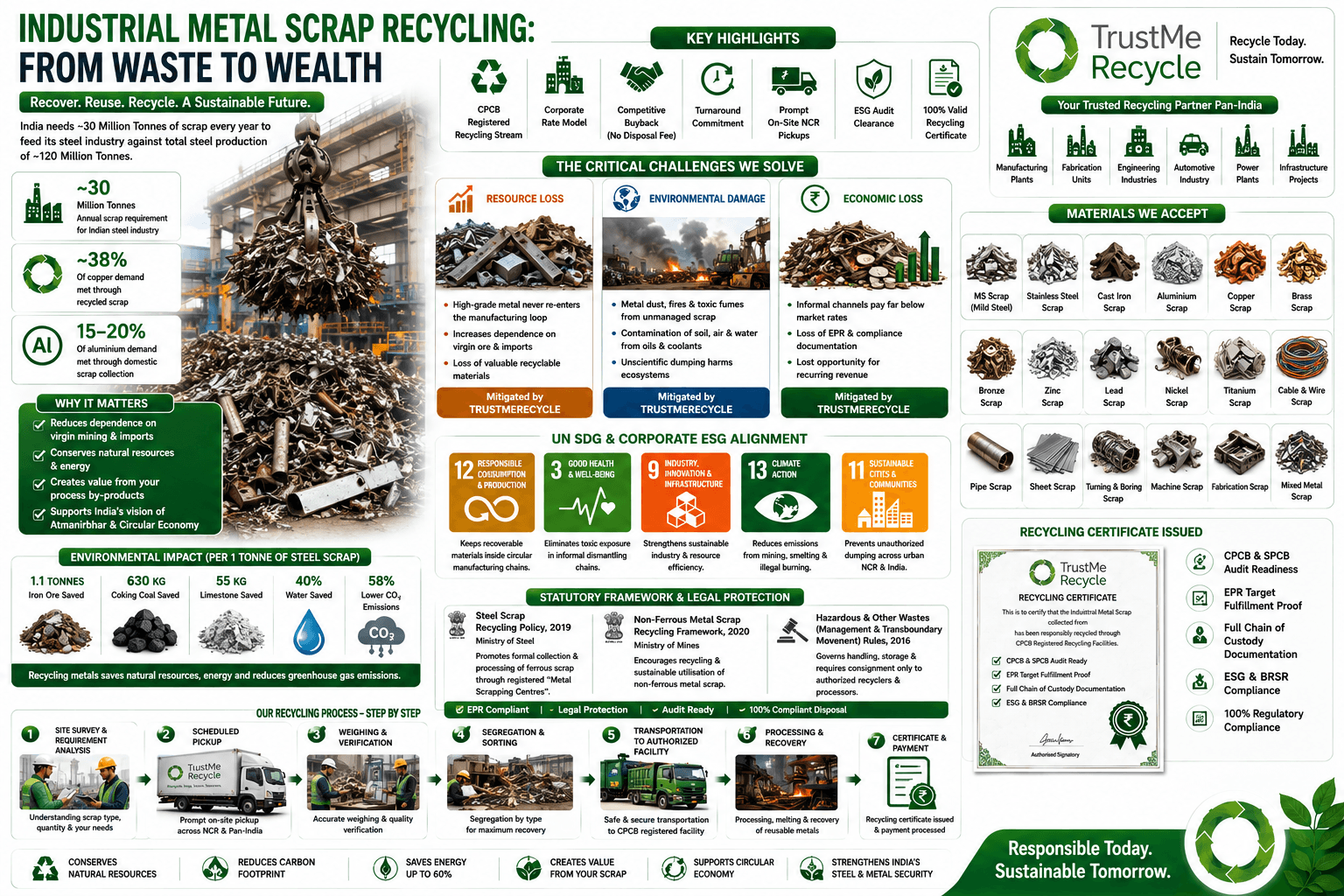
Beyond the ferrous and non-ferrous scrap generated by offices and facilities, manufacturing plants, fabrication shops, and industrial units generate a distinct stream of process scrap — mild steel (MS) scrap, stainless steel scrap, turnings and borings from machining, cable and wire offcuts, pipe and sheet scrap, and fabrication waste. India's crude steel industry needs roughly 30 million tonnes of scrap a year against total production of around 120 million tonnes, a requirement projected to keep rising as the country targets 300 million tonnes of annual steel production (Ministry of Steel / PIB). On the non-ferrous side, roughly 38% of India's copper demand is already met through recycled scrap, while domestic aluminium scrap collection still meets only 15-20% of industry raw-material needs, with the rest met through imports (industry data cited by AlCircle / The Core).
For manufacturing and fabrication operations, this process scrap is generated continuously as a byproduct of production — not a one-time clearout — and represents a recurring revenue opportunity when it's captured and sold through the right channel instead of accumulating in a corner of the shop floor.
Key Highlights
Processing Model
CPCB Registered Recycling Stream
Corporate Rate Model
Competitive Buyback (No Disposal Fee)
Turnaround Commitment
Prompt On-Site NCR Pickups
ESG Audit Clearance
100% Valid Recycling Certificate
Materials We Accept
The specific industrial metal scrap sub-types TRUSTMERECYCLE buys, collects, and routes to compliant recycling.
The Critical Challenges We Solve
Unregulated waste disposal creates severe health risks, environmental damage, and financial losses.
Resource Loss
Process scrap left unsold or discarded informally means high-grade recyclable metal never re-enters the manufacturing loop, forcing continued reliance on virgin ore mining and imports.
Environmental Damage
Unmanaged scrap yards and informal dismantling generate metal dust and fires when mixed with cutting oils, coolants, or flammable materials common in industrial process scrap.
Economic Loss
Businesses that sell process scrap through unregistered, informal channels typically get paid far below fair market rates for high-value streams like turnings, borings, and cable scrap, and lose the documentation needed to prove compliant disposal.
Health Risk Breakdown
Informal handling of process scrap — cutting, shredding, or burning off cutting oils and coolants from turnings and machine scrap — releases metal particulates and fumes, posing respiratory risk to workers operating without protective equipment. Sharp edges and heavy loads at unregulated yards also carry high injury risk, particularly with sheet and fabrication scrap.
Environmental Impact
Recycling steel instead of producing it from virgin ore saves an estimated 1.1 tonnes of iron ore, 630 kg of coking coal, and 55 kg of limestone per tonne of scrap used, while cutting water consumption by roughly 40% and greenhouse gas emissions by roughly 58% (Ministry of Steel, Steel Scrap Recycling Policy 2019 figures). Copper, aluminium, and other non-ferrous metals in process scrap are infinitely recyclable without loss of quality — recovering them directly displaces energy-intensive primary smelting.
UN SDG & Corporate ESG Alignment
Partnering with TRUSTMERECYCLE provides auditable proof for corporate BRSR disclosures and international sustainability standards.
Industrial metal scrap recovery supports SDG 9 (Industry, Innovation and Infrastructure), SDG 12 (Responsible Consumption and Production), and SDG 13 (Climate Action). For manufacturing and fabrication businesses, formally recycling process scrap is also a direct compliance and cost-recovery lever — turning a production byproduct into a documented, auditable revenue stream rather than an unmanaged liability.
Responsible Production
Keeps recoverable materials inside circular manufacturing chains.
Good Health & Well-being
Eliminates toxic exposure in informal dismantling chains.
Climate Action
Reduces emissions tied to virgin mining and illegal burning.
Sustainable Cities
Prevents unauthorized waste dumping across urban NCR.
Regulatory Rules & Legal Protection
Ferrous process scrap sits under the Steel Scrap Recycling Policy, 2019, issued by the Ministry of Steel, which promotes formal collection and processing of end-of-life and process ferrous scrap through registered "Metal Scrapping Centres." Non-ferrous process scrap sits under the Non-Ferrous Metal Scrap Recycling Framework, 2020, issued by the Ministry of Mines. Both streams fall under the Hazardous and Other Wastes (Management and Transboundary Movement) Rules, 2016, which governs handling and requires consignment only to authorized recyclers and processors.
Recycling Certificate Issued
Every consignment concludes with an official document suitable for corporate audits, EPR compliance, and government inspections.
How TRUSTMERECYCLE Handles Industrial Metal Scrap
A transparent 6-step recycling lifecycle built for scale, accountability, and regulatory clearance.
Assessment & Competitive Quote
We evaluate your process scrap — MS, stainless steel, turnings, borings, cable, pipe, and sheet scrap — and offer a competitive buy-back rate reflecting current market pricing.
Frequently Asked Questions
Ready to Clear Out Your Industrial Metal Scrap?
Schedule a free on-site evaluation in Gurugram & NCR. Get fair competitive market pricing, prompt pickup, and official CPCB compliance certificates.