
Dry Waste Recycling
Chairs, crates, bottles, bins, and packaging plastic — PET, HDPE, PVC, LDPE, PP, PS & ABS.
Compliance
CPCB Authorized
Audit Trail
Official Certificate
Experience
25+ Yrs Leadership
Certified Dry Waste Recycling
Full chain-of-custody collection, authorized processing, and CPCB green audit clearance across NCR.
Understanding Dry Waste Recycling in India
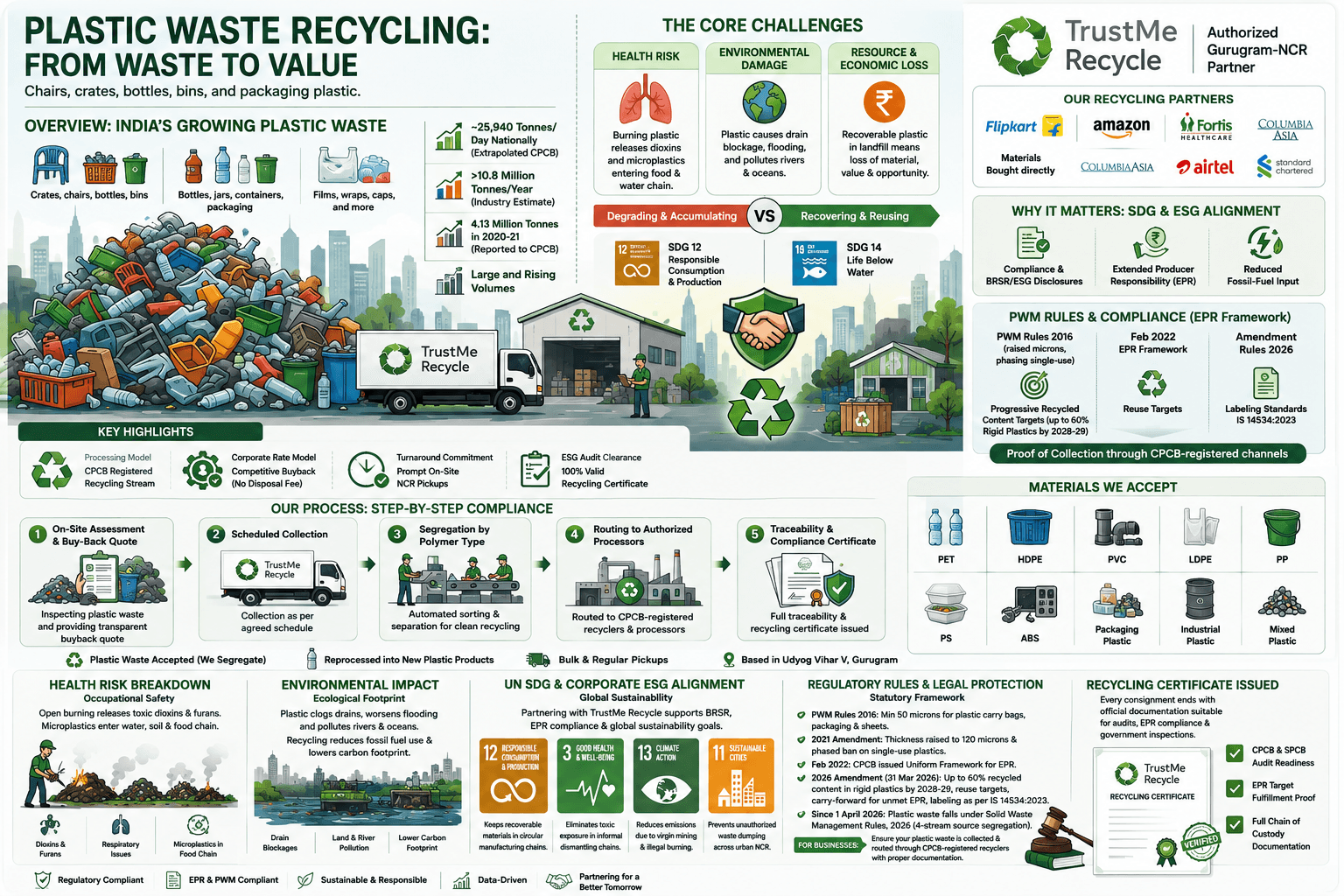
Plastic waste is one of the fastest-growing and most visible parts of India's dry waste stream. A Central Pollution Control Board study across 60 major cities found roughly 4,059 tonnes of plastic waste generated per day in those cities alone, which CPCB extrapolated to an estimated 25,940 tonnes per day nationally. On an annual basis, independent estimates put India's plastic waste generation at over 10.8 million tonnes in 2023 — around 7.6 kg per person (industry estimate, 2023). Separately, 35 states and union territories reported approximately 4.13 million tonnes of plastic waste generated in 2020-21 through official CPCB reporting channels — the range across these figures reflects how differently plastic waste is measured and reported across the country, but the direction is consistent: volumes are large and rising.
Behind these numbers sits everyday plastic scrap that businesses generate constantly and rarely think to recover value from — chairs, tables, storage crates, product covers, packaging pellets, bottles, and bins clearing out of warehouses, malls, hospitals, and corporate offices. TRUSTMERECYCLE buys this material directly rather than letting it go to landfill or informal disposal.
Key Highlights
Processing Model
CPCB Registered Recycling Stream
Corporate Rate Model
Competitive Buyback (No Disposal Fee)
Turnaround Commitment
Prompt On-Site NCR Pickups
ESG Audit Clearance
100% Valid Recycling Certificate
Materials We Accept
The specific plastic waste sub-types TRUSTMERECYCLE buys, collects, and routes to compliant recycling.
The Critical Challenges We Solve
Unregulated waste disposal creates severe health risks, environmental damage, and financial losses.
Health Risk
Informal burning of plastic waste, common where organised collection doesn't reach, releases dioxins and furans linked to serious health effects; degrading plastic also breaks down into microplastics that are now well-documented as entering food and water sources.
Environmental Damage
Plastic is non-biodegradable and a leading cause of drain and waterway blockage in Indian cities, contributing directly to urban flooding as well as river and eventual ocean plastic pollution.
Resource & Economic Loss
Recyclable plastic — crates, bottles, pellets, rigid packaging — that ends up in landfill instead of being reprocessed represents recoverable material and value lost, when the same plastic could be reintroduced into manufacturing supply chains.
Health Risk Breakdown
Open burning of plastic scrap — still common in areas without organised waste collection — releases toxic emissions including dioxins and furans, associated with respiratory and other long-term health effects for nearby communities. As plastic waste degrades in the environment, it fragments into microplastics that have been found accumulating in water supplies, soil, and the food chain, an exposure pathway that affects far more people than just those near a dump site.
Environmental Impact
Plastic waste is a major contributor to drain and waterway blockages across Indian cities, worsening monsoon flooding — a problem repeatedly documented in Delhi-NCR. Because plastic does not biodegrade, the volumes accumulating in landfills, rivers, and eventually oceans keep growing rather than being naturally absorbed. Recovering and reprocessing plastic scrap into new material — rather than manufacturing virgin plastic each time — also reduces the fossil-fuel input associated with plastic production.
UN SDG & Corporate ESG Alignment
Partnering with TRUSTMERECYCLE provides auditable proof for corporate BRSR disclosures and international sustainability standards.
Diverting plastic scrap into proper recycling channels supports SDG 12 (Responsible Consumption and Production) and SDG 14 (Life Below Water), given plastic's outsized role in waterway and ocean pollution. For businesses, plastic waste management is also directly tied to compliance: Extended Producer Responsibility (EPR) obligations under Indian plastic waste law apply to producers, importers, and brand owners, and proper documentation of plastic waste disposal increasingly feeds into corporate BRSR and ESG disclosures.
Responsible Production
Keeps recoverable materials inside circular manufacturing chains.
Good Health & Well-being
Eliminates toxic exposure in informal dismantling chains.
Climate Action
Reduces emissions tied to virgin mining and illegal burning.
Sustainable Cities
Prevents unauthorized waste dumping across urban NCR.
Regulatory Rules & Legal Protection
Plastic scrap in India is governed by the Plastic Waste Management Rules, 2016, as amended over several rounds. The original 2016 Rules raised the minimum thickness for plastic carry bags, packaging, and plastic sheets to 50 microns. The Plastic Waste Management Amendment Rules, 2021 raised this further to 120 microns and set out a phased ban on identified single-use plastic items. In February 2022, CPCB issued the Uniform Framework for Extended Producer Responsibility, formalising EPR obligations for producers, importers, and brand owners. Most recently, the Plastic Waste Management (Amendment) Rules, 2026 (notified 31 March 2026, G.S.R. 237(E)) introduced progressive recycled-content targets for packaging — rising as high as 60% for rigid plastics by 2028-29 — reuse targets for brand owners, a carry-forward mechanism for unmet EPR targets, and labelling standards under IS 14534:2023 for recycled-content packaging.
Since 1 April 2026, plastic scrap collection also sits inside the wider Solid Waste Management Rules, 2026, which mandate four-stream source segregation — wet, dry, sanitary, and special care — with plastic classified under "dry waste" alongside paper, glass, and metal. For businesses generating plastic scrap — rather than producing plastic packaging — the practical compliance need is simpler but just as important: proof that plastic waste is being collected and routed through CPCB-registered recyclers and processors rather than informal or unregulated channels.
Recycling Certificate Issued
Every consignment concludes with an official document suitable for corporate audits, EPR compliance, and government inspections.
How TRUSTMERECYCLE Handles Dry Waste
A transparent 6-step recycling lifecycle built for scale, accountability, and regulatory clearance.
On-Site Assessment & Buy-Back Quote
We assess your plastic scrap — chairs, tables, crates, covers, pellets, bottles, bins — and quote competitive buy-back rates based on volume and material type.
Frequently Asked Questions
Ready to Clear Out Your Dry Waste?
Schedule a free on-site evaluation in Gurugram & NCR. Get fair competitive market pricing, prompt pickup, and official CPCB compliance certificates.