
Lighting Equipment Recycling
LED bulbs, CFLs, tube lights, and mercury lamps.
Compliance
CPCB Authorized
Audit Trail
Official Certificate
Experience
25+ Yrs Leadership
Certified Lighting Equipment Recycling
Full chain-of-custody collection, authorized processing, and CPCB green audit clearance across NCR.
Understanding Lighting Equipment Recycling in India
LED bulbs, CFLs, tube lights, and mercury lamps replaced during facility retrofits and lighting upgrades are one of the most overlooked e-waste streams — often swept into general trash despite being explicitly regulated. Mercury-containing lamps such as fluorescent tubes and CFLs are a notified category (CEEW4) under India's e-waste rules, meaning the fittings your facility replaces don't belong in general waste. India's broader e-waste volumes rose from around 10.1 lakh metric tonnes generated in 2019-20 to over 13.9 lakh metric tonnes in 2024-25 (CPCB/PIB, 2025), a trend that includes lighting waste alongside consumer and IT electronics.
For malls, hospitals, warehouses, and corporate campuses running large-scale lighting retrofits — often replacing CFLs and tube lights with LEDs — the volume of decommissioned fixtures adds up fast, and mishandling it carries a mercury-exposure risk that general scrap dealers routinely ignore.
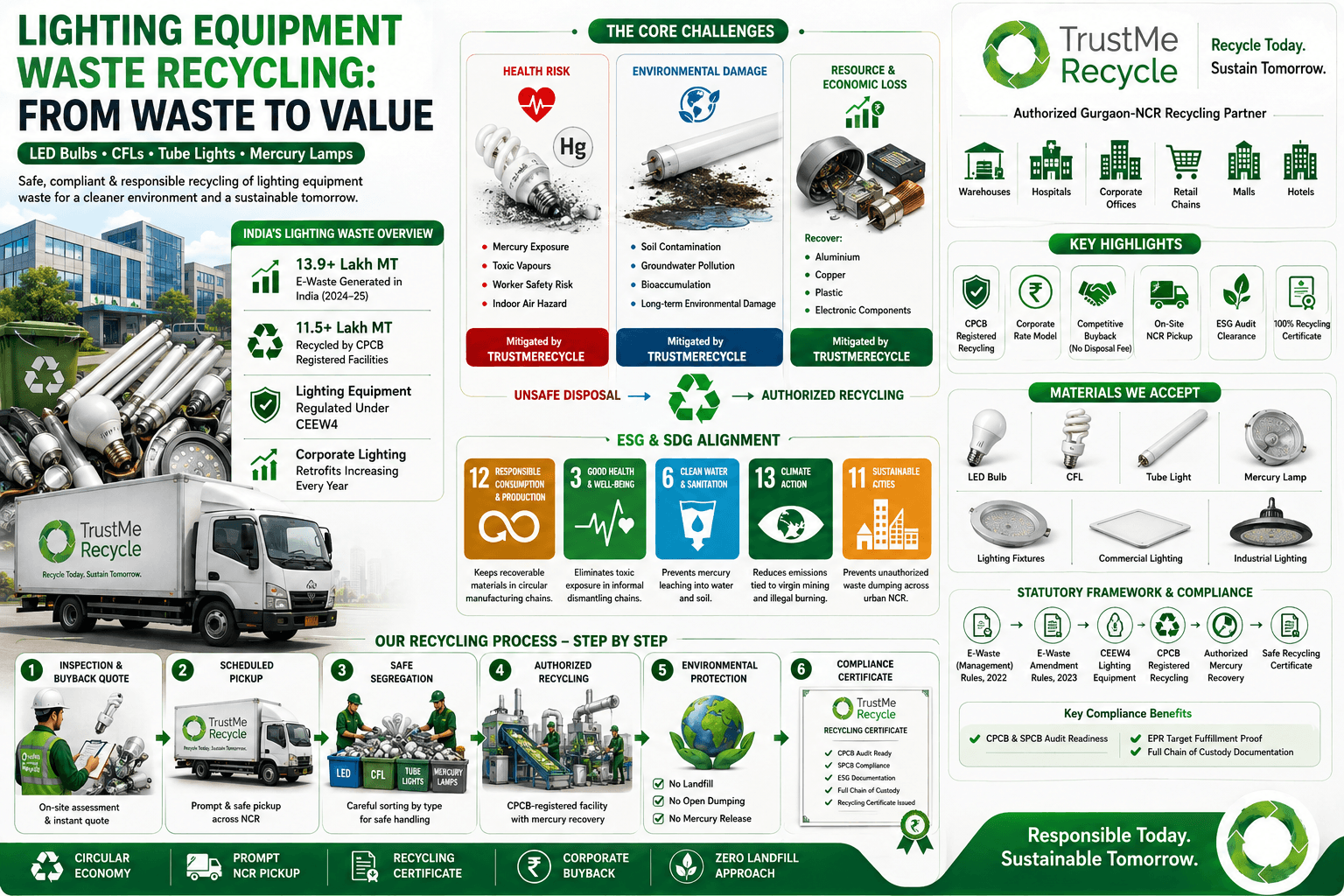
Key Highlights
Processing Model
CPCB Registered Recycling Stream
Corporate Rate Model
Competitive Buyback (No Disposal Fee)
Turnaround Commitment
Prompt On-Site NCR Pickups
ESG Audit Clearance
100% Valid Recycling Certificate
Materials We Accept
The specific lighting equipment sub-types TRUSTMERECYCLE buys, collects, and routes to compliant recycling.
The Critical Challenges We Solve
Unregulated waste disposal creates severe health risks, environmental damage, and financial losses.
Health Risk
Fluorescent tubes, CFLs, and older mercury lamps contain mercury. Breaking these open informally — a common practice in scrap yards — releases mercury vapour directly into the immediate environment.
Environmental Damage
Discarded lamps, if landfilled or crushed informally, leach mercury into soil and groundwater — a persistent, bioaccumulative toxin.
Economic Loss
LED fixtures contain recoverable metals and electronic components; even lower-value CFLs and tube lights, when properly processed, avoid the cleanup cost of mercury contamination that dumping creates.
Health Risk Breakdown
Mercury exposure from broken fluorescent tubes and CFLs — common when lighting waste is dumped or crushed informally — is linked to nervous system, kidney, and respiratory harm, with particular risk to children and pregnant women (WHO). Workers handling broken lamps without protective equipment in India's informal scrap sector face repeated low-dose mercury exposure that accumulates over time.
Environmental Impact
Mercury from broken lamps is a persistent environmental contaminant — it doesn't break down, bioaccumulates up the food chain, and contaminates soil and groundwater for years once released. Proper collection and processing recovers mercury safely for controlled disposal or reuse, rather than allowing it to disperse through landfill or informal crushing. LED fixtures, while mercury-free, still contain recoverable metals and plastics worth reclaiming rather than landfilling.
UN SDG & Corporate ESG Alignment
Partnering with TRUSTMERECYCLE provides auditable proof for corporate BRSR disclosures and international sustainability standards.
Authorized lighting waste disposal supports SDG 3 (Good Health and Well-Being) by keeping mercury out of unsafe informal handling, and SDG 6 (Clean Water and Sanitation) by preventing mercury leaching into groundwater. For facilities running large-scale LED retrofits — a common sustainability initiative in itself — properly disposing of the CFLs and tube lights being replaced closes a compliance gap that's easy to overlook amid the retrofit's own ESG narrative.
Responsible Production
Keeps recoverable materials inside circular manufacturing chains.
Good Health & Well-being
Eliminates toxic exposure in informal dismantling chains.
Climate Action
Reduces emissions tied to virgin mining and illegal burning.
Sustainable Cities
Prevents unauthorized waste dumping across urban NCR.
Regulatory Rules & Legal Protection
Lighting equipment falls under the E-Waste (Management) Rules, 2022 (in force since 1 April 2023) and the E-Waste (Management) Amendment Rules, 2023, which classify lighting equipment as CEEW4 under Schedule I. Producers bear Extended Producer Responsibility (EPR) obligations, and end-of-life units must go to CPCB-registered recyclers with facilities equipped for safe mercury recovery. Recyclers and dismantlers handling the e-waste fraction of lighting equipment must be registered on CPCB's centralized portal.
Recycling Certificate Issued
Every consignment concludes with an official document suitable for corporate audits, EPR compliance, and government inspections.
How TRUSTMERECYCLE Handles Lighting Equipment
A transparent 6-step recycling lifecycle built for scale, accountability, and regulatory clearance.
Assessment & Competitive Buy-Back
Share details of your LED, CFL, tube light, and mercury lamp volumes; we assess and offer a competitive purchase rate.
Frequently Asked Questions
Ready to Clear Out Your Lighting Equipment?
Schedule a free on-site evaluation in Gurugram & NCR. Get fair competitive market pricing, prompt pickup, and official CPCB compliance certificates.